
House Raising and House Lifting in New Jersey
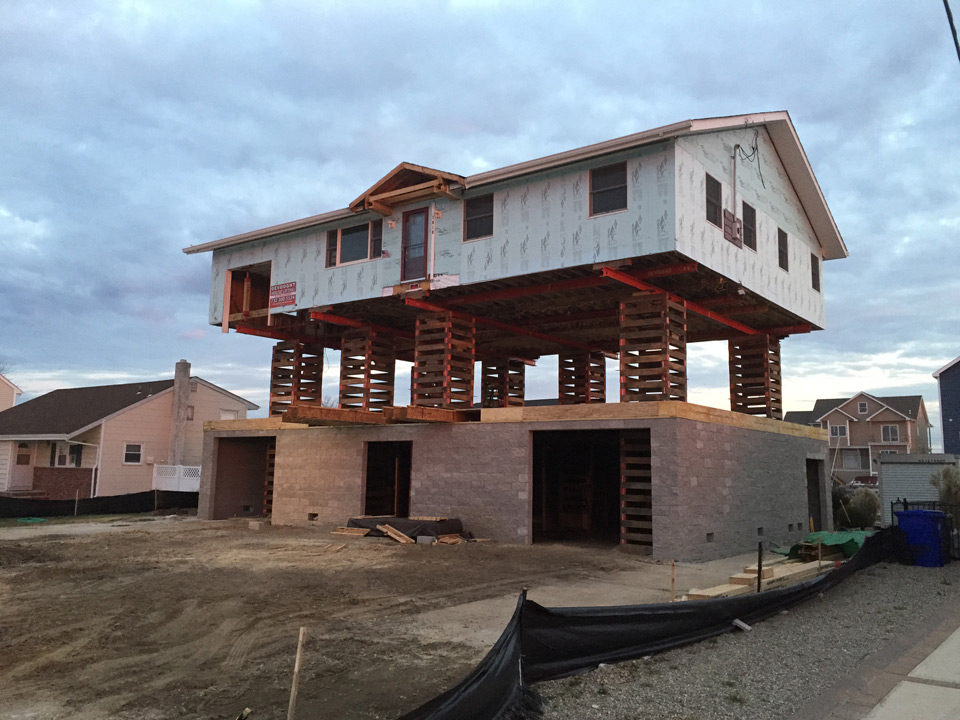
Lifting your home in New Jersey may be required to protect it from flood damage. Homeowners raise their houses primarily as a preventative measure against flood damage, particularly in regions that are affected by rising water levels.
This process not only safeguards your property but also ensures the safety of your family during extreme weather conditions. In many cases this may be required before any major renovation can occur.
Protect Your New Jersey Home from Catastrophic Damage
Over the years, the Jersey Shore area has been subjected to extremely damaging and dangerous weather resulting in several homes being ruined beyond repair.
Protect your home from catastrophic damage, especially in areas like the Jersey Shore that are prone to severe weather events. Raising the entire house can protect it from catastrophic damage. With our house lifting services, you can add a new layer of protection to your ground-level home, safeguarding your property against future flood damage and rising sea levels.
Need steps you can take before the next storm? Read our storm preparation guide.
The Need for House Lifting in New Jersey
The Jersey Shore has been heavily impacted by destructive weather, including the devastating effects of Hurricane Sandy in 2012. According to the Federal Emergency Management Agency (FEMA), Hurricane Sandy caused an estimated $65 billion in damage, with many homes along the shore suffering irreparable harm. In response to this widespread devastation, insurance companies and regulatory agencies have implemented stricter guidelines for flood protection, leading to an increase in house-lifting projects to mitigate future risks.
Benefits of House Lifting
Mitigating Flood Damage
Elevating your home above the base flood elevation (BFE) or raising a house can significantly reduce the risk of flood damage during extreme weather events and storm surges. Homes built above BFE also tend to qualify for lower flood insurance rates.
Enhancing Resilience
By raising your home and strengthening its foundation, you can increase its resilience to natural disasters, protecting your investment and ensuring the safety of your family.
Often, steel beams are placed under the floor framing at support points to enable the synchronized lifting process, ensuring the house is adequately supported while the foundation is being raised and built anew.

Compliance with Regulations
Many homes along the Jersey Shore are subject to regulatory requirements mandating elevation to meet flood zone standards. Our house lifting services help homeowners comply with these regulations while ensuring the structural integrity of their properties.
Requirements vary by town and flood zone, and we confirm them before any work starts.
Our House Lifting Process
Consultation and Assessment
We begin with a thorough consultation to assess your property’s specific needs and determine the most effective house lifting solution.
It is important to disconnect utilities and secure valuables before the project begins to ensure safety and proper planning.
Existing Foundation Preparation
Depending on your existing foundation, we may install helical pilings, extend the foundation, or demolish and construct a new foundation to support your raised home securely. Modern house lifting techniques often utilize hydraulic jacks, which allow for synchronized lifting, ensuring minimal structural disturbance while providing support as the house is raised and new foundations are constructed.
Foundations can be implemented on any surface
Your current foundation may sit too low, or you may need a brand new one. Chap can build on:
- Crawl spaces
- Slabs
- Foundations (if currently too low)
Has your raised home foundation been damaged?
From cracks and disjointing to uneven flooring and new flood zone requirements, Chap can help. Your foundation may need a repair or an update to meet new protection guidelines. Trust the team that’s been in business and serving the Jersey Shore since 1972 to ensure your home is safe.
During the house lifting process, temporary supports, such as cribs, are used to provide stability while new foundation walls are constructed below.


Lifting and Adjustment
Our experienced team works in conjunction with licensed contractors to raise your home safely and adjust the existing foundation directly beneath it. We ensure precise elevation to meet regulatory requirements and maximize flood protection.
Steel beams are strategically positioned under the house to provide essential structural support during the lifting process.
Repair and Maintenance
If your raised home’s foundation has been damaged or requires updates to meet current protection guidelines, we provide comprehensive repair and maintenance services to ensure its long-term stability and resilience.
Chap also utilizes house raising techniques for entire floor additions when renovating or remodeling. House jacking is a complex process that may be part of larger renovations aimed at increasing livable space or adding value to a home.
How High Does Your House Need to Go?
Your home’s minimum height starts with the base flood elevation, or BFE. That’s the flood level with a 1% chance of happening in any year. Most towns add extra height on top, often called freeboard. Together they set the design flood elevation your lowest floor must clear. Our guide to flood zone building requirements explains how to check your zone.
New Jersey adopted its REAL coastal flood rules in 2026. They could raise that target further, though full implementation has been delayed. We confirm the current requirement with your town before design starts.
What Drives the Cost of Raising a House
Every lift is priced after an assessment, since no two shore houses are alike. These factors move the number most:
- How high the house has to go
- The foundation type your flood zone requires
- House size, weight and condition
- Site access on tight lots
- New stairs, decks and utility work after the lift
- Any renovation or addition done at the same time
Flood insurance may help. NFIP policies include Increased Cost of Compliance coverage, which can pay up to $30,000 toward compliance work like elevation. It applies after substantial flood damage or repeated flood losses.
Lift Now, Renovate or Add On
Raising a house opens up options most owners don’t expect. The lifted home needs new stairs, entries and often decks. Many owners also add a level or rework the floor plan while the house is up. The space below can serve as parking and storage.
Because Chap is a design-build contractor, one team manages the lift, the permits and the renovation. You don’t have to coordinate separate companies. Learn more about adding a level and renovation and remodeling.
What House Raising Clients Say
CHAP was wonderful to work with on my house lift and addition. The entire staff was professional, organized and responsive.
Ann C.
I couldn’t have been happier with Chap Construction when I had my house raised. They completed their work faster than estimated.
Nick Z.
House Raising FAQs
Most homes can. Chap can build on crawl spaces, slabs and foundations that sit too low. The assessment checks framing, condition and site access before anything is planned.
No. Utilities are disconnected, and the house rests on steel beams and cribbing during the work. Plan on living elsewhere until it is set down, reconnected and inspected.
It depends on permits, the foundation type and any renovation you add. Permit review alone can take a while in some towns. You’ll get a schedule after your assessment.
Most problems come from poor planning, like a weak beam layout or rushed cribbing. That’s why assessment and engineering come first. Careful lifting keeps the structure supported at every stage.
Often, yes, once the lowest floor sits above BFE. Your rate depends on your zone, elevation certificate and policy. Ask your agent to quote both scenarios.
Yes. Elevation work needs local permits and inspections, and flood zone rules apply. Chap handles the permit process from start to finish.
Chap Construction is your trusted partner for house lifting and flood protection services in New Jersey. Schedule a no-risk consultation today and take the first step towards safeguarding your home against future disasters.